Last Tuesday, while browsing a clearance sale on a well-known retail website, I came across a sleek espresso-finish coffee table advertised at a steep discount—from $400 down to $149. At first glance, it appeared to be an exceptional deal. However, before making the purchase, I decided to take a moment to compare prices elsewhere.
A quick search revealed the same coffee table listed on three other websites, none of which labeled it as “on sale.” Each of them priced the item at $135. This comparison made it clear that the $400 “original price” was misleading and did not reflect the product’s true market value.

This scenario illustrates a common marketing tactic known as price anchoring. Retailers often display inflated reference prices to create the perception of significant savings. While this strategy can be effective, a thoughtful and value-driven approach to shopping focuses less on dramatic discount percentages and more on identifying the lowest genuine price.
In this guide, you will learn how to interpret MSRP pricing accurately, recognize deceptive sales tactics, and use practical tools to ensure you make informed purchasing decisions—without paying more than necessary.
Understanding MSRP: The "Suggested" Price vs. Reality
The Manufacturer’s Suggested Retail Price is really just a polite suggestion from the people who made the product to the people selling it.
Retailers in the USA aren't legally forced to stick to this number. It acts more like a ceiling than a floor. Most of the time, it’s set intentionally high to give stores some breathing room for promotions without hurting their bottom line. Think of it like a suggested recipe on the back of a pasta box. It tells you a basic way to do things, but the best results usually happen when you make your own tweaks based on what’s actually in your kitchen.
MSRP represents the highest price a manufacturer thinks they can get away with, but the real magic happens at the invoice price, which is what the store actually paid. That gap is where the retailer makes their money. In the US market, flexibility is key because competition is so stiff that stores almost always drop below the MSRP to grab your attention. Even market conditions play a huge role; if a new model is coming out next month, that "suggested" price becomes even less relevant.
I’ve noticed that for things like mattresses or high-end blenders, the MSRP is almost purely decorative. If you pay the full sticker price, you're likely paying for the store's marketing budget rather than the actual quality of the product itself.
The Psychology of the "Strikethrough": How MSRP Creates Fake Savings
We’ve all seen that bold, red line through a high price. It’s designed to trigger a "dopamine hit" that shuts off the logical part of your brain.
This is called the "Anchoring Effect." Once you see $1,000, your brain uses that as a benchmark, so when you see $600, it feels like a bargain even if the item is only worth $400. These anchor prices set a mental trap to make the "sale" price look irresistible. You’ll see this a lot at places like T.J. Maxx or Marshalls, where "Compare At" pricing is often just an estimate of what a "similar" item might cost elsewhere, not a real historical price.
Retailers also love using artificial urgency, combining a fake high price with a countdown timer to make you check out faster. Sometimes these are just inventory flushes where the MSRP is kept high just so a store can claim a "70% off" clearance event to move old stock. I used to fall for this all the time with bed sheets. I’d see "80% off!" and buy three sets, only to realize later that the "original" price was so inflated that no one in their right mind would have ever paid it.

Now, I use price-tracking browser extensions to see the real history of an item. If the "original price" hasn't actually been charged in the last 90 days, that discount isn't real. It’s just a meaningless number on a screen.
MSRP vs. Market Price: Finding the "Street Value"
The market price is the reality check. It’s what people are actually swiping their cards for right now in the real world.
In the USA, market prices change fast because of "dynamic pricing" algorithms. If you're shopping for a 4K TV, you'll see the MSRP stay the same on the box all year, but the actual price at the register will drop every single month as newer tech gets announced. Tech and appliances almost always sell way below MSRP because the technology ages so quickly. On the flip side, prestige brands like Apple or Dyson stick close to MSRP to keep their "luxury" image, but you can still find deals through authorized dealers if you're patient.
The "Street Value" is really the average price across major retailers like Amazon, Walmart, and Target. You also have to watch for seasonal shifts, where market prices dip during specific US holidays like Labor Day or Memorial Day regardless of what the MSRP says. I remember helping my brother buy a fridge last summer. The MSRP was $2,400, but by checking a few different local zip codes online, we found a "market price" of $1,850.
We didn't even need a special coupon; we just needed to know the actual street value. Knowing the difference saves you from the stress of hunting for a non-existent 90% off coupon. Usually, the "market price" is already a fair deal if you know where to look.
Red Flags: How to Spot Inflated MSRPs in Online Shopping
Online marketplaces have made it way easier for brands to "fake" their value. I see this a lot with private-label brands on Amazon.
A brand you've never heard of will list a pair of headphones for an MSRP of $299 and then immediately "discount" them to $39. It makes you think you're getting a studio-quality piece for a steal, but really, they were always $39 headphones. You should always be skeptical of a high MSRP from unknown brands that you can't find in a brick-and-mortar store. I often right-click a product image to do a reverse search and see if the same item is sold under five different names for cheaper elsewhere.
You also have to watch out for dynamic pricing traps where the price goes up just because you've looked at the item a few times; clearing your cookies or using an incognito window can help. Also, be careful with third-party sellers on sites like Walmart or Amazon, as the MSRP they list might be totally made up. Last month, i saw a "professional" massage gun for $200 off, but a quick image search showed the exact same model on a wholesale site for $15.
The MSRP was a total lie designed to make a cheap plastic tool look like medical equipment. It pays to be a little bit of a detective. If a deal looks too good to be true, it’s usually because the "original" price was never true to begin with.
When Paying MSRP Actually Makes Sense
Believe it or not, there are times when I actually don't mind paying the full suggested price. It sounds crazy for a deal hunter, but it's about "value retention."
Some brands are so committed to quality and fair labor that they rarely, if ever, have sales. Brands like Patagonia or certain high-end cookware offer a lifetime warranty, meaning the product won't end up in a landfill in six months. You might also run into high-demand items like the latest PlayStation or a viral wellness tumbler where you’re lucky to even find it at MSRP. In these cases, paying the sticker price is often the only way to get the item without dealing with marked-up resellers.
It’s also worth checking your US credit cards for "Price Protection" perks, as many will refund the difference if the price drops shortly after your purchase. For limited editions or collector's items, the MSRP is often the lowest price it will ever be. To me, this is the core of conscious consumption. I’d rather pay MSRP for one pair of boots that last ten years than buy five "discounted" pairs that hurt my feet. It’s the "buy once, cry once" philosophy. If I know an item will improve my daily comfort for years, I’m okay with the sticker price, but only after I've confirmed that a real sale isn't just around the corner.
The Smart Shopper’s Toolkit: Beating the Sticker Price
You don't need to spend hours scrolling to save money. I’ve narrowed it down to a few "micro-habits" that take about 60 seconds.
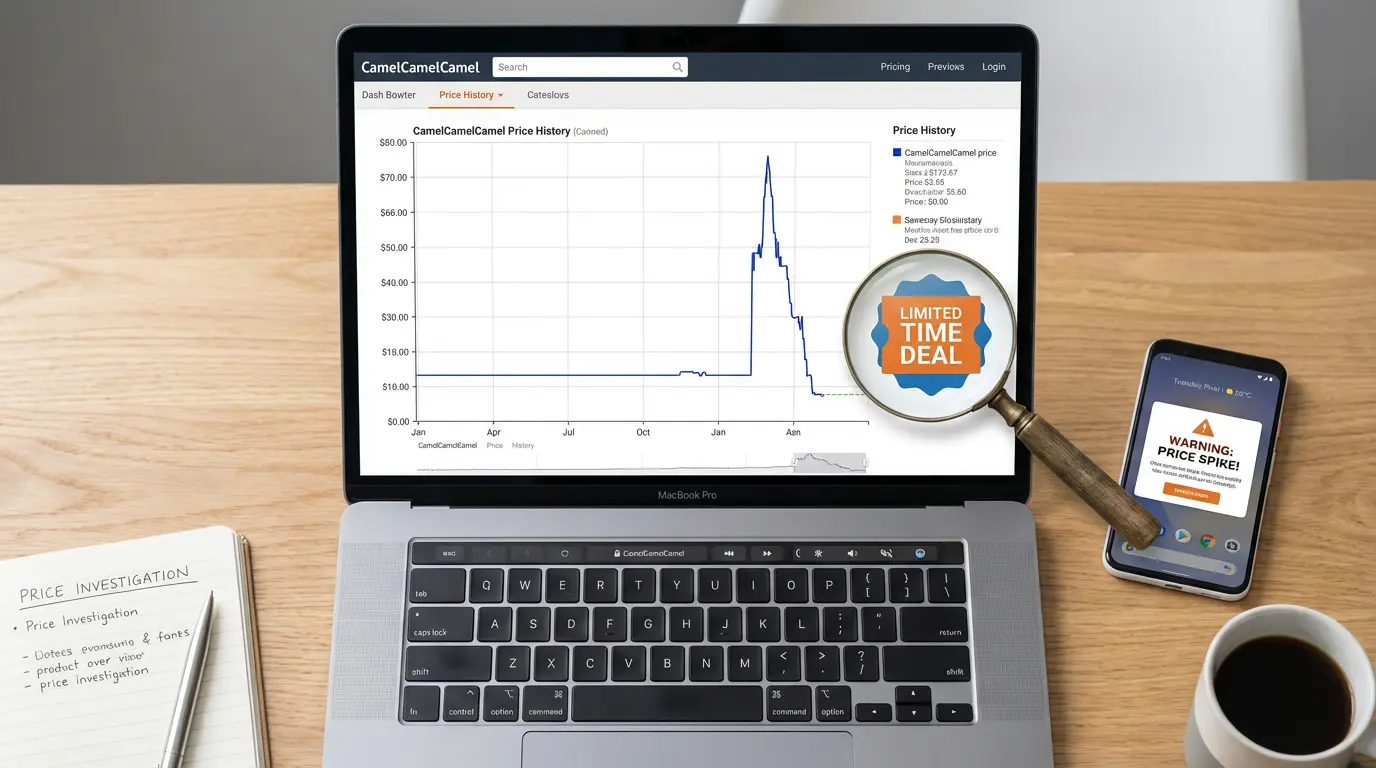
Before I hit "buy" on anything over $50, I run through a quick mental checklist. It’s saved me thousands of dollars over the last few years and keeps my house from being filled with "sale" clutter I don't actually need. Price history trackers like CamelCamelCamel or Keepa are absolute life-savers because they show you a graph of the price over time so you can see if the current "sale" is actually a low point.
I also use coupon aggregators and browser extensions that automatically test promo codes at checkout. Even if an item is already below MSRP, a stackable coupon can often take off another 15%. Comparison engines like Google Shopping are great for seeing a side-by-side of every major US retailer’s price instantly. If the price is stubbornly stuck at MSRP, I’ll use a cashback site like Rakuten to at least get 5% or 10% back in my pocket. I make it a game. If I can't find a way to beat the sticker price in under two minutes, I ask myself if I really need the item today. Usually, the answer is no.
Beyond the Tag: Other Costs the MSRP Hides
The MSRP is just the beginning of the story. I’ve learned the hard way that a "low" price can get very expensive very quickly.
In the USA, we have to deal with shipping costs and varying state sales taxes that aren't on the sticker. Sometimes a store will list an item way below MSRP but then charge $40 for "heavy freight" shipping, and suddenly that deal isn't a deal anymore. You should always look at the "Total" at the final checkout screen before you get excited. Often, a $100 item with free shipping is a much better value than an $85 item with $20 shipping.
You also have to consider return shipping; some "discount" sites don't offer free returns, so if the item doesn't work out, you might lose $15 just to send it back. Don't forget installation costs for big stuff like dishwashers, where the MSRP doesn't include the $150 fee for someone to actually hook it up.
.webp)
I bought a "discounted" rug once that was $50 below the MSRP, but the shipping was $60 and it was non-returnable. It was the wrong color, and I was stuck with it. Now, I always factor in the "landed cost"—the price of the item sitting in my living room, not just the price on the tag.
Conclusion
At the end of the day, MSRP is just a marketing suggestion. It’s a tool used by brands to tell a story about how much their product is "worth." But you get to decide what it’s worth to you.
Living a frugal, intentional life isn't about being "cheap." It’s about being smart enough to see through the psychological tricks of big retail. When you stop focusing on the percentage you "saved" and start looking at the actual dollars leaving your bank account, your relationship with shopping changes.
You’ll find you have more money for the things that actually bring you joy—like a weekend trip or a really good meal—because you stopped overpaying for "suggested" prices. You have the power to be a conscious consumer. Next time you see a strikethrough price, just smile and know that you know better.
FAQs
Is MSRP fake?
No, but it’s often used in a misleading way.
Do stores have to sell at MSRP?
No. It’s only a suggestion.
Why does my cart price change?
Dynamic pricing, location, and taxes can all affect it.
Can I pay less than MSRP?
Almost always. Just compare and wait.