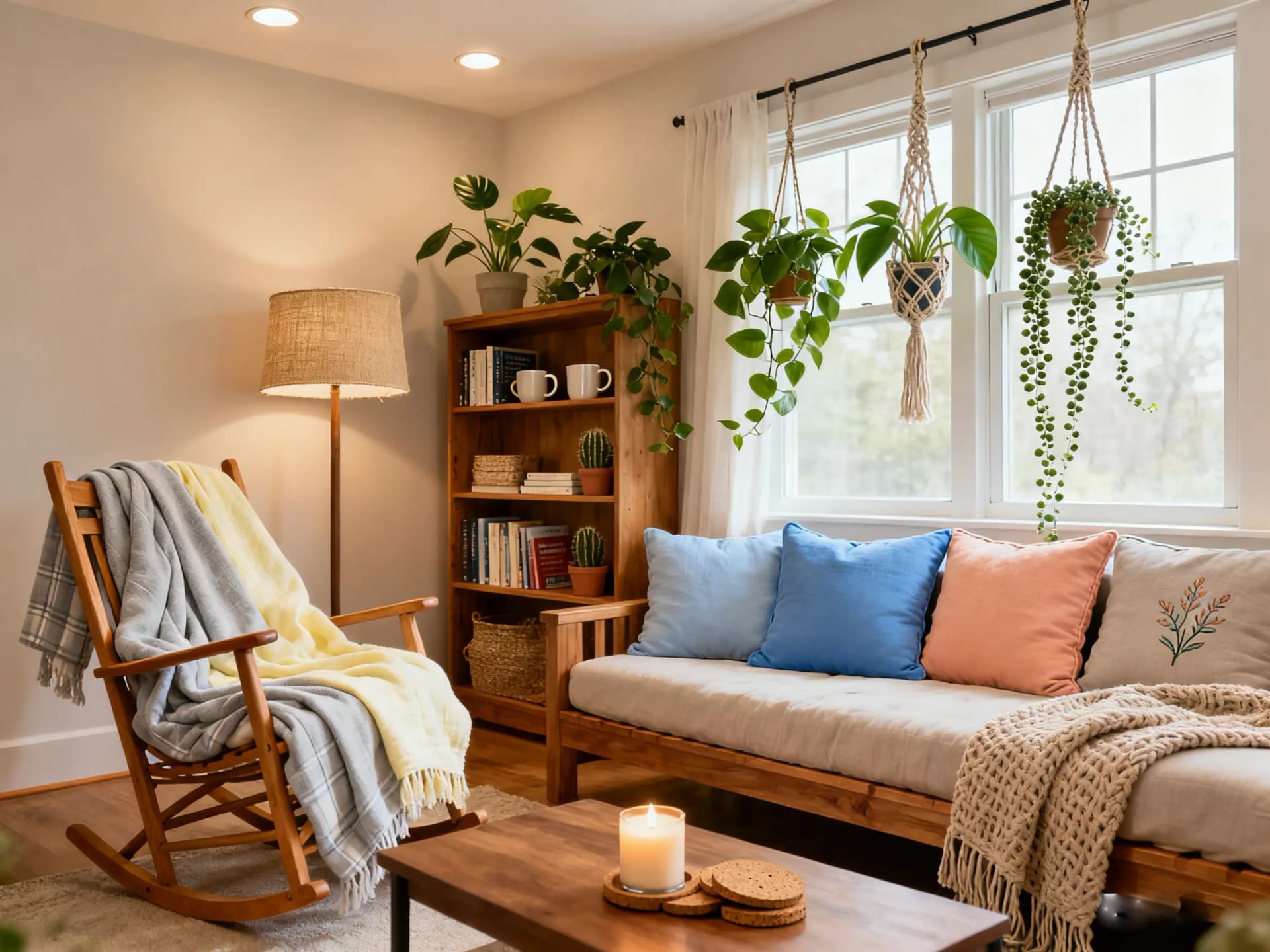
Residing in a flat or a dormitory room teaches you a great deal rather fast: there is never a neutral space. Everything you have around you either helps you to maintain your routine or silently opposes it. When your bed, desk, closet and even your kitchen are close to each other by a few steps, the clutter ceases to be a visual problem and becomes a mental problem.
I have been staying in rooms such as this. In such spaces, organization had no relation to trends and style. It was functional, rhythmic and maintenance of mental energy. Mess is heavier and accumulates faster when there is a lack of space. The advantage is that small rooms react to intelligent arrangement exceptionally. Even minor, intentional modifications can totally turn the atmosphere in the space around.
What ensues are practical and lived in strategies that can be applied in the real studios and dorm rooms. Nothing staged. Nothing theoretical.
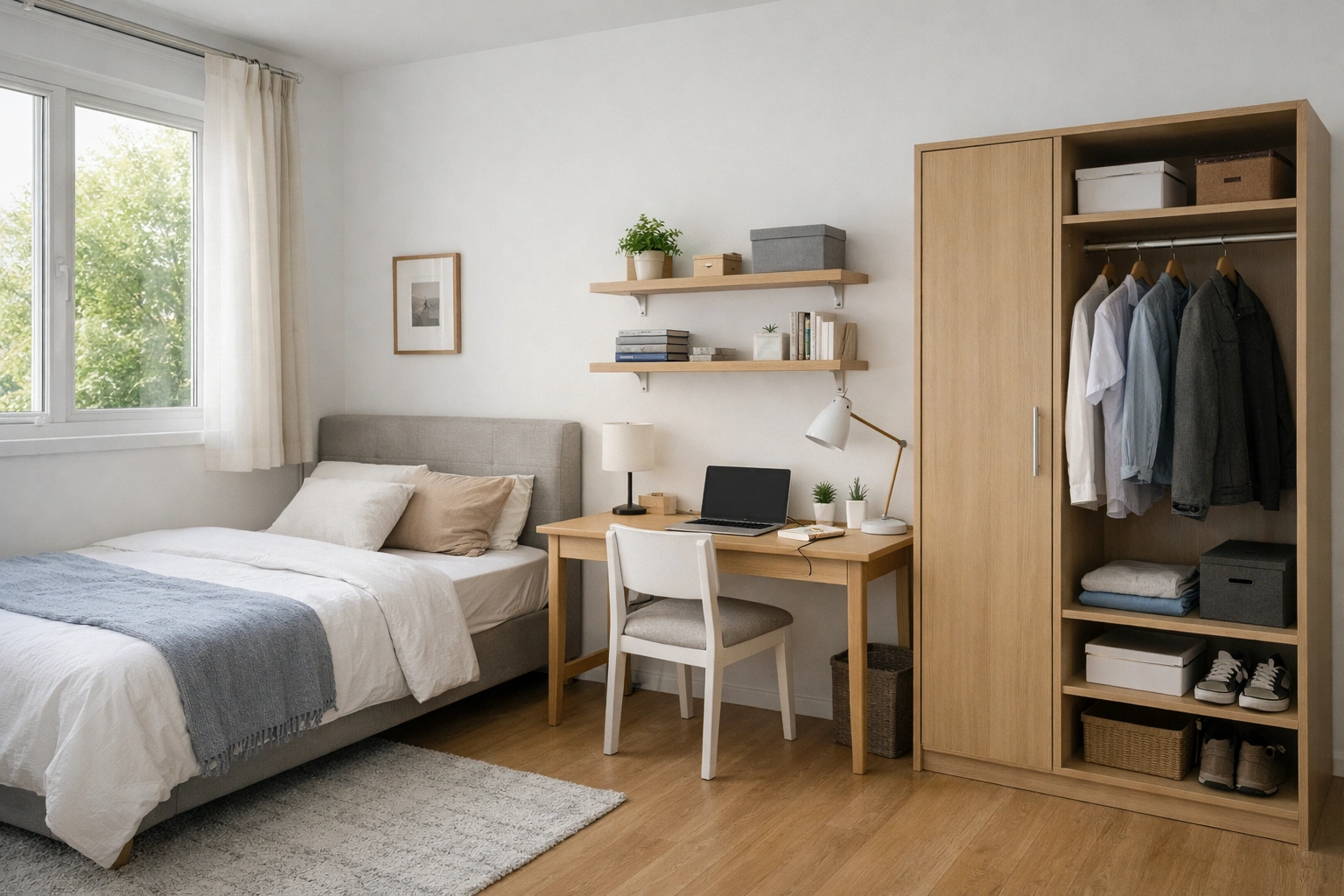
Begin With How You Really Live
You only need to spend a few days just observing your habits before you buy storage bins or even reorganize your furniture. Notice the easy place you always drop your bag, where clothes always seem to accumulate, and what you reach for without even thinking about it.
Cramped areas do not accept imposed systems. When you arrange according to your wish of how to live rather than the way you live, the arrangement will not be successful. I even attempted to stuff my day to day objects in drawers since that was cleaner. In another week all moved back to my desk.
Convenience always wins. When it is not convenient to get something, it will be in a visible place. Good organization means that it does not work against your behavior.
Divide the Room Into Clear Zones
With a whole house in a single room your life is not there.
Establishing demarcated areas will avoid the spread of chaos everywhere. Common zones include:
- Sleeping
- Studying or working
- Getting dressed
- Relaxing
- Eating
These areas do not require walls to be defined. A shift in purpose can be indicated in the way your furniture is placed, the use of rugs, lighting or even the direction in which your furniture is directed.
As an illustration, leaving all your work related stuff at your desk and not at any other place will help to keep notebooks, chargers at the workstation and not at the bed. This division also assists your brain to relax when you work. Zones mixed complicate the rest, despite the appearance of an orderly room.
Use Vertical Space Before Adding Furniture
Floor space in small rooms is soon gone. Walls are, however, not utilized much.
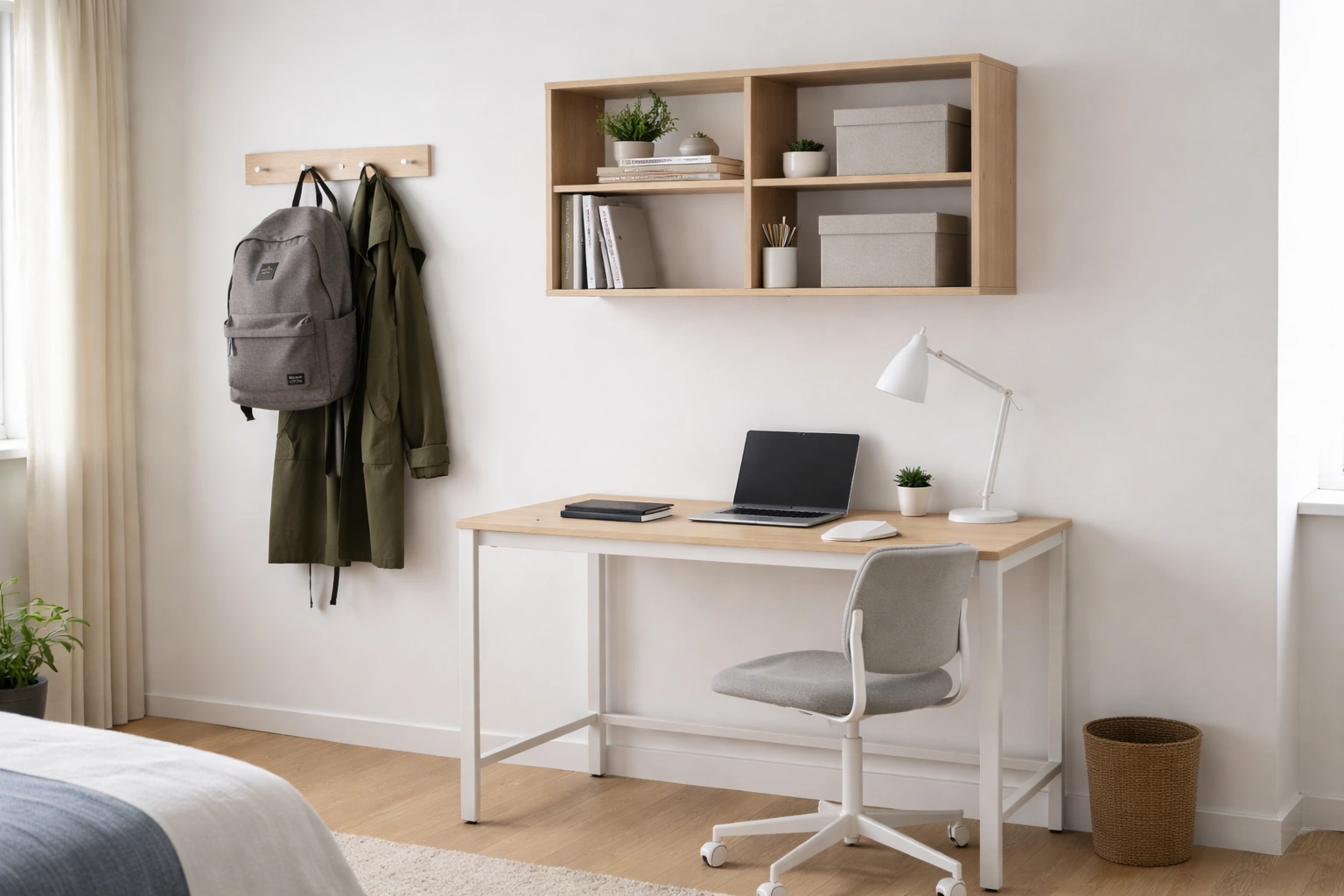
Always check up before you put in another piece of furniture. Wall hooks, narrow shelves and tall storage can take off the foot strain on the floor but will not clog the room. The key is restraint. Making all the walls one-coloured is aesthetically noisy.
As you can see more of the floor, the room instantly becomes bigger and more relaxed. Vertical storage is most effective when it addresses an apparent issue rather than just decoration.
Be Intentional With Under-Bed Storage
There should be no dumping of under-bed space. It can be one of the best storage spaces in a studio or a dorm when used wisely.
Ideal tools to use under the bed:
- Seasonal clothing
- Extra bedding or towels
- Rarely used items
This is not a place of daily necessities. When you are forced to creep under the bed, you get frustrated so easily, and you have to mess up everything around. This space is not chaotic but functional as there are shallow labeled containers.
Choose Furniture That Does More Than One Job
Every piece of furniture in a small room should not be unjustified by the area that it covers. Furniture that has storage or doubles as another purpose minimizes the additional objects and contributes to the openness of the room.
That being said, functionality shall never supersede comfort. An all-purpose thing which is cumbersome to use will not make it through your daily routine. The most comfortable furniture does not impose its style on you but allows you to live as you please.
Keep Open Storage Limited and Purposeful
The open storage may very well be quite effective in a small area, provided that it is managed.
Open storage works best for:
- Daily essentials
- Most frequently used notebooks or books.
- Frequently used casual clothes.
Once open storage begins to fill up it is an indication that something requires editing. Physical order is as significant as visual relaxation in small rooms. There are some deliberate open spaces that are better than a lot of the disorganized spaces.
Arrange Clothes according to reality and not by type
Closets used in the studios and dormitories tend to be small and thus the storage of clothing needs to be honest. Rather than categorizing it into ideal categories, categorize it according to the way you dress.
Wearable clothes should be simple to access. Products that are rarely used should be stored higher or further. Closet can be made to look more orderly and less cluttered by simply using uniform hangers.
Among the greatest changes that I made is changing the stacked folding to vertical folding in the drawers. Drawers are self-organizing when everything is visible simultaneously. As the storage of clothes indicates real routines, the laundry piles are reduced automatically.
Clear Surfaces Create Instant Calm
Everything is heavier in a small room where there are cluttered surfaces. Clear surfaces need to be kept mostly uncluttered with only the necessities on display such as desks, nightstands and dressers.
This is not a question of minimalism or constraint. It is all about eliminating talk in the head. The reduced number of things in the view makes the room appear fresher, although there may be no significant change in the quantity of goods.
Lighting Changes How Organized a Room Feels
Lighting is not a significant concern, yet it contributes significantly to the experience of a given space. A single unflattering overhead light is enough to make a small room's atmosphere stuffy.
There is depth and warmth provided by the light. The room has a focused light used during work time, warmer light used during evenings and low mellow light used during relaxation, which makes the room purposeful. Good lighting does not alter the scale of the room but it alters the experience of a room.
Do Small Resets Instead of Big Cleanups
Organization cannot succeed on the basis of motivation. Small rooms have both short and repeatable resets.
A simple reset might include:
- Returning items to their zones
- Clearing the desk
- Putting clothes back in place
An hour of maintenance will save hours of cleanup time. Unity is much more important than excellence.
Be Selective With Personal Items
It is important to use personal touches, particularly in temporary places such as dorm or rent. However, in situations where the sentimental things are in all places, the room may be oppressive rather than comforting.
Pick a couple of places that you want to capture pictures, books or significant things. This does not make the room personal to the point of saturation.
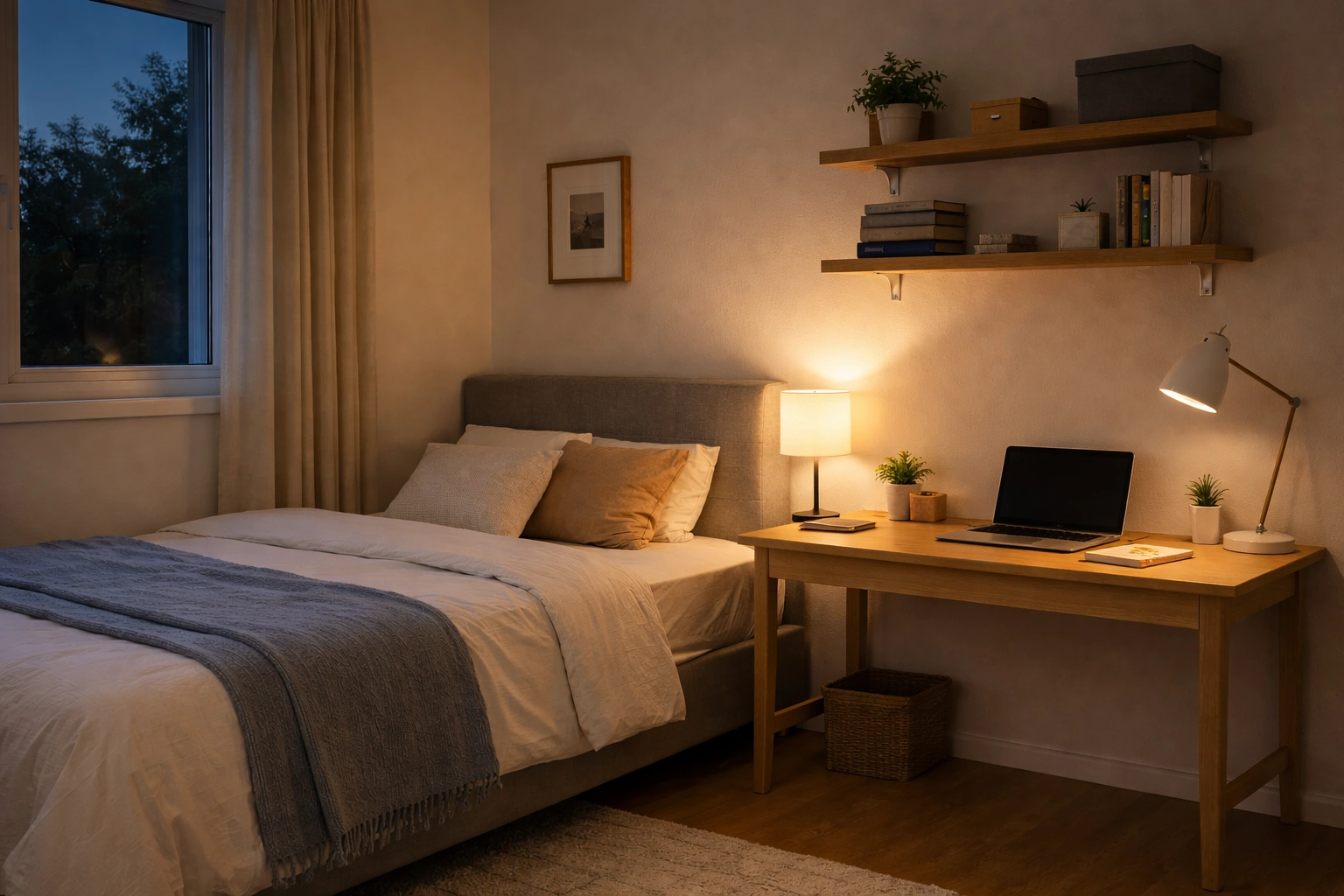
Accept That Small Spaces Need Ongoing Adjustment
Your routine will change. Your schedule will shift. Your arrangement is to advance with it.
Planning a studio or dorm space is not a one-time process of trying to get a perfect system. It is all about being sensitive to your living life. Even a tiny room will become comfortable, practical, and thematic when your space promotes your habit rather than opposes it.
Do not clean up everything immediately in case clutter is overwhelming to you. Select one area, your desk or bedside table and purge it. Minor victories bring momentum particularly in small domains.
Frequently Asked Questions
What will I do to maintain my small apartment or dormitories in the long run?
Consistency is the key and not perfection. Little spaces can be kept tidy with areas assigned and you do frequent, brief cleanups. Five minutes of cleaning every day or week is much more efficient than the deep cleansing that is done every so often.
What should I prioritize organizing first in a small room?
Begin with the space where you spend most of your time. It is often your desk or bedside table. De-congesting a congested area provides a temporary relief and efforts become less daunting to work on momentum.
Which is the better to use, an open or a closed storage in a small space?
Both have a place. Open storage is ideal with things that you use daily unlike closed storage which is best with things that produce a noise to the eye. The balance is more important rather than picking one against the other.
What should I do in order to make my apartment or dorm less messy without disposing of everything?
Pay attention to being seen instead of being heard. Even when you leave most of your things in a room, cleaning the surfaces, enhancing lighting, and using a vertical store will make the room look much more relaxing.
On what frequency should I rearrange a small space?
There’s no fixed schedule. Rearrange when you change your routine or when the room begins to play the opposite game with you. Minimal areas require periodic redesign, but not regular redesign.