Everyone has had the experience of going to the bathroom cabinet scurrying away after a kitchen accident involving a paring knife or scraped knees after a hike on the weekend. You draw out that shining red plastic box—the one that boasts of 100 items of life-saving equipment—and find that 80 of those items are little circles, a quarter of an inch across, and incapable of remaining on a finger more than five minutes.
The tweezers are fashioned from of the cheapest plastic material that is incapable of picking up a piece of lint, let alone a splinter and the antiseptic wipes are drier than bone. This is anxiety of IFAK (Individual First Aid Kit). When there is a small crisis at hand, the last thing you need is to find out that you have been using a kit that was 70 per cent filler and 30 per cent low-grade fluff.
However, the great news is that professional level safety does not belong to paramedics and wilderness guides. Thinking about purchasing individual bulk components instead of ready-made kits can allow you to create a hospital-grade kit that is of your own modification under 50 dollars. This is not merely about saving money but the peace of mind knowing that this time your gear is going to be useful when you need it the most.

Why the Majority of Ready-Made First Aid Kits are a Poor Investment
You will find kits with 300 pieces and more in a big-box retailer for $25. It seems like a steal, but according to a conscious consumption perspective, it is a trap. In the DIY vs store-bought first aid kit, the calculation often turns out to favor the store version only in theory.
The Piece Count Trap
The majority of retail kits are based on the "Piece Count Trap." These kits are filled with cheap fillers by manufacturers such as dozens of safety pins, tiny plastic bandages, paper-thin gauze, etc., to make a consumer think that they get more out of their money.
The Quality Gap
Besides, a large Quality Gap exists. The plastic tweezers or the dull and tiny scissors in these kits are not used by professionals. In order to cut through a heavy pant leg to access a wound, you require trauma shears, and not craft scissors.
The Problem of Expiration
Lastly, there is the problem of expiration. Ready-to-use kits can be stored in warehouses or spend months or even years on retail shelves. By the time they get home, the bonding agents could be collapsing and the sterile wipes could be withering. The philosophy of Quality over Quantity consists in the understanding that a single roll of high-adhesion cohesive wrap is worth more than fifty generic bandages which fall off the moment you move.
The Economics of Bulk Medical Supplies
The key to a professional quality make-over on a low-budget is the knowledge of the unit price. You just paid a lot of money at a local pharmacy when you purchased a small box of ten sterile gauze pads. Nonetheless, you can, in most cases, find the 100 pads in boxes when you are looking up bulk medical supplies and can get those boxes at only a few dollars more than the 10-pack.
The Shared Supply Model
Purchasing in large quantities will enable you to adopt a so-called Shared Supply. Rather than purchasing 3 smaller and poor-quality kits at home, in your car, and in your travel bag, you purchase one big inventory of quality supplies and share it. This guarantees the same level of consistency with all of your kits—you will know how to utilize your equipment anywhere.
Shelf-Life Strategy
When buying medical supplies in large quantities, you should concentrate the budget on the ones that have a long shelf-life Strategy. All such products as sterile gauze, medical tape, and tools made of stainless steel do not expire. When you hoard these when you come across a site-wide promotion code or a bulk purchase discount, you are, in a way, paying to be safe over a period of years at a fraction of the rate. A browser extension to monitor the state of prices on medical supply websites works wonders towards landing these necessities at its lowest price point.
The Professional-Grade Shopping List
What should be contained in a professional first aid kit? It is not the possession of everything, but it is what is right.
Advanced Wound Care
Begin with high-tech wound care. Get beyond the regular bandage and see hydrocolloid dressings (sometimes referred to as blister bandages, or second skin). These produce a moist environment which accelerates healing and lasts days even during showers. Substitute your normal water bottle with sterile water flushes to clean the wounds without stinging your skin with alcohol.
Structural Support and Pro Tools
Another area that retail kits cannot achieve is structural support. An elastic wrap of high quality (such as Ace bandage) and an aluminum splint should be included with a pro kit. These will enable you to rest a sprained ankle or a fractured finger correctly.
Finally, invest in your tools. The jewelry of your first aid kit is a pair of $7 stainless steel trauma shears and a pair of fine-tipped metal tweezers. They are efficient, robust, and are lifetime effective.

The 50-Dollar Budget Breakdown
Construction of an economical first aid kit does not imply purchasing something inexpensive but purchasing wisely. The following is the way you can spend that $50 to increase your safety:
The $25 Bulk Core
This is the base. You will use half your money on boxes of high-counts of sterile gauze, 6 packs of the cohesive wrap known as vet wrap, and a big box of the various heavy-duty fabric bandages.
The $15 Tool Tier
Use this amount of money on two trauma shears and quality tweezers. These are single-time purchases that enhance the utility of your kit in real time.
The $10 "Ointment and Prep"
Use generic-brand triple antibiotic ointments, burn gels, and antiseptic wipes. The name brand and the store brand are the same chemically, and they are usually available in the clearance section, or with pharmacy loyalty benefits, they are virtually free. You can easily reduce this cost even more by utilizing the funds in FSA/HSA because you are spending pre-tax money on these vital health supplies.
Changing Bulk Supplies to Functional Kits
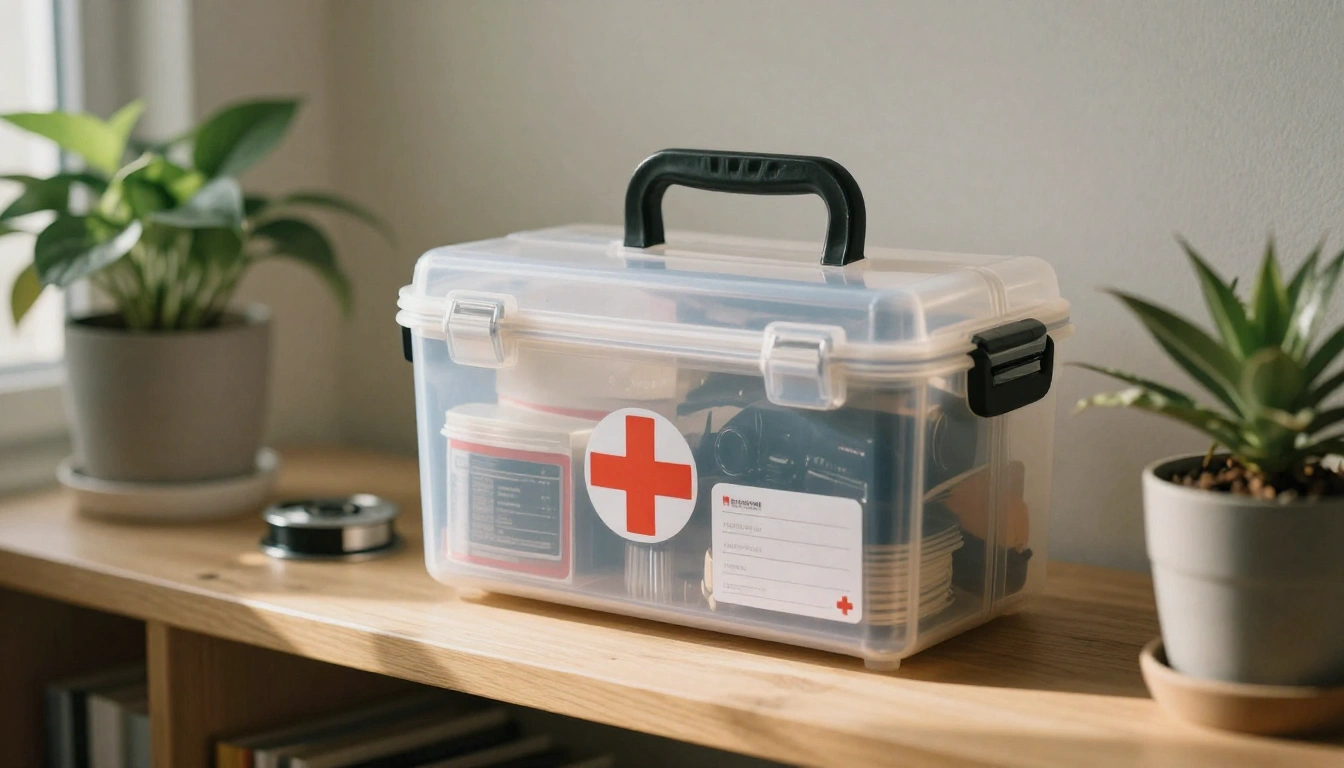
The next thing to do after you have your bulk first aid supplies is to organize. You do not have to purchase an expensive medical bag. Repurposing brings some of the finest ideas of organizing the household. A durable plastic tackle box or a multi-compartment craft box with a clear top will be a great home kit since everything is clear and you can see it at a glance.
The "Zone" Method
Arrange your supplies by the "Zone" Method. Categorize group items as to the nature of injury: Small Cuts and Scrapes, Major Bleeding/Trauma, and Bites and Burns. This will not allow you to take a mountain of gauze and go digging through to get one sting-relief pad when someone is suffering.
Labeling for Speed
Use bold, clear labels. When you are in a stressful situation, the speed with which your brain processes information reduces; simplify things (or a guest) to locate what exactly is required.
The Best Deals on Medical Gear
You must have the right place to shop in order to make your overhaul cost less than $50. But do not have the convenience markup of the corner drug store. Rather, turn to online wholesalers in medicine. These locations are meant to serve clinics, though commonly available to the general population.
Near-Date Liquidation and Subscription Models
Search: Near-Date Liquidation. Most wholesalers also sell items such as antiseptic wipes or ointments that are about to expire their official date at close to 80% discount. In products you need regularly, such as the case of adhesive bandages for your house with children, the Subscribe and Save model is your new best friend. It also usually has a 5-15 percent discount and sells out never. You should always visit a cashback portal before you shop to check whether you will get a percent of what you buy back.
Maintenance and Sustainability
One of the indicators of conscious consumerism is a refillable first aid kit. You are assembling a modular system, rather than having to add to the retail cycle of buy-and-toss of cheap kits.
The Annual Audit
Carry out an Annual Audit every year, maybe on Daylight Savings. Verify the stock of expired drugs and supplement with those that are necessary.
Greener Substitutes
In case you are a person concerned with sustainability, seek greener substitutes in your bulk purchases. A variety of brands have begun to sell bandages based on bamboo and biodegradable prep pads. Since you are making a bulk purchase, the comparatively increased cost of these sustainable alternatives is offset by the saving of your DIY strategy, in general.
Conclusion
Creating a first aid kit that is of professional quality is not about having deep pockets; it is about being a conscious buyer. When you select bulk medical supplies and set your sights on the quality of the tools, you are not just saving money—you are investing in the resiliency of your family.
Such a 50-dollar upgrade will transform fluff in the form of the number of pieces to a real useful item, making a junk-filled drawer a potential life-saving tool. Fundamentally, intentional living is all about being ready to take a hiccup in life so that you could get back to the joyful moments that count.
FAQ
Can I really spend less on a kit that I build?
Yes. Although the initial outlay may seem like a retail kit, the price-per-unit on bulk purchases is much more affordable, and there will be no need to spend money on filler items that will never be utilized.
Which bulk medical supplies last the longest time on the shelf?
Non-liquid products such as sterile gauze, medical tape, aluminum splints, trauma shears, and elastic bandages have virtually unlimited shelf life provided that they are kept in a cool and dry location.
Is it possible to buy bulk supplies using HSA/FSA?
The HSA/FSA is eligible for most first-aid items, such as bandages, thermometers, and ointments. It is like receiving a 20-30% discount using these pre-tax dollars.
At what frequency do I need to replenish my DIY kit?
A bi-annual check-up is best. It just takes ten minutes to change any of the items that you have utilized and make sure that your ointments are not out of date.